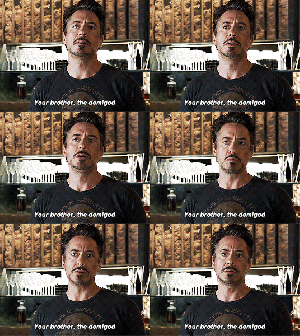
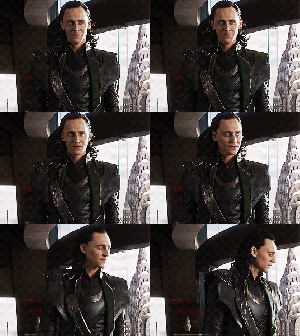
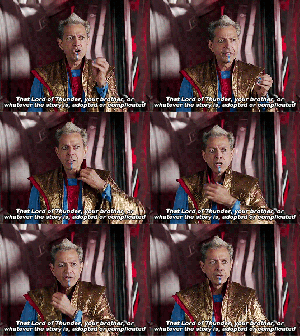
Loki after someone mentions Thor: Would it kill you to put my existence first for once? I mean come on all he’s done is save people, I’VE KILLED THEM!!
Thor used to pick a fight and kill people in the past while endanger his own friends. Loki used to keep Thor out of trouble or avoid an uncecessary fight. It’s a bit ironic isn’t it?
Loki after someone mentions Thor: Would it kill you to put my existence first for once? I mean come on all he’s done is save people, I’VE KILLED THEM!!
When I read shit like this, I wonder if people are watching the same movies that I’ve watched. Or if they have paid attention at all while doing so. Thor is a violent person. He has taken MANY lives. He enjoys doing so. Not even because he is a bad guy, but because it is part of his culture. He has spent far more screen time committing violence than Loki.
Loki, on the other hand, is not a naturally violent person. It was one of the reasons he didn’t fit in so well on Asgard. He has taken lives as well. Though probably not as many as Thor. But somehow the audience comes away with this notion that Loki is this bloodthirsty killer. Even when he’s just sitting there, doing nothing, the audience is thinking “wow, he’s evil.”
As an educator, I make it my mission to teach children how to critically analyze fiction. Not only so that they can grow up to watch movies and NOT draw ridiculous conclusions like this one, but so they can apply that skill to their assessment of real life people as well.
Loki after someone mentions Thor: “Would it kill you to allow me some measure of autonomy? I am an actual person. My existence is not contingent on Thor’s existence.”
FIXED.
Thank you!
I guess this all happens because the first Avengers movie and Thor: Ragnarok are fresher and livelier in the minds of the popular collective vs Thor 1 and Thor 2.
The Avengers has Loki acting desperate after being brainwashed by a literal death cult and in Thor 3 the director (and possibly Hemsworth too?) took a machete to both Thor and Loki’s characterization in the name of humor.
It doesn’t help that many of the clues that there is more to Loki than the mask he presents in the two movies are in deleted scenes or in blink-and-you-miss-it moments that take rewatches or screencaptured-gifs for most film watchers to catch; heck, I took everything at face value the first time I watched the films until I saw tumblr posts that showed those moments!
I was surprised to find that, yes, Loki was crying real tears when he stabbed Thor in the Avengers, that he was tempted to go home with him but still hurting from what his point of view had been a colossal life-long betrayal from his whole family, Thor’s friends and even Heimdall in Thor 1, and the deleted scene in The Avengers 1 when Loki talks mentally to The Other for a second time should never have been deleted, because it showed us that Loki was being supervised 24/7 even when he wasn’t holding the Scepter, which is a game-changer in explaining what went on in that movie.
Oh, God, all the deleted scenes. We cannot have people sympathizing with Loki, that is madness.
You could argue that Thanos is written to be more sympathetic to the audience in Avengers: Infinity War than Loki was by this stage of the MCU:
“Boo hoo, I really loved Gamora even though I abused and tortured her and all my kidnapped/adopted children which I orphaned in the first place!”
“I really believe in my vision of a just world, I’m just misguided!”
There is something sad about that.
Nice input. The Infinity War writer and director are trying to make Thanos more sympathetic than Loki.
So it’s a common tumblr headcanon that Thor’s speech about Mjolnir was reflecting his relationship with Loki.
Then we have Korg’s speech which, when I first saw the movie, I found hilarious, but only that. At first glance Korg is not doing much more than unintentionally mocking Thor’s hammer fetish so that we realize how silly his fixation with Mjolnir is. No hidden meaning there. Right?
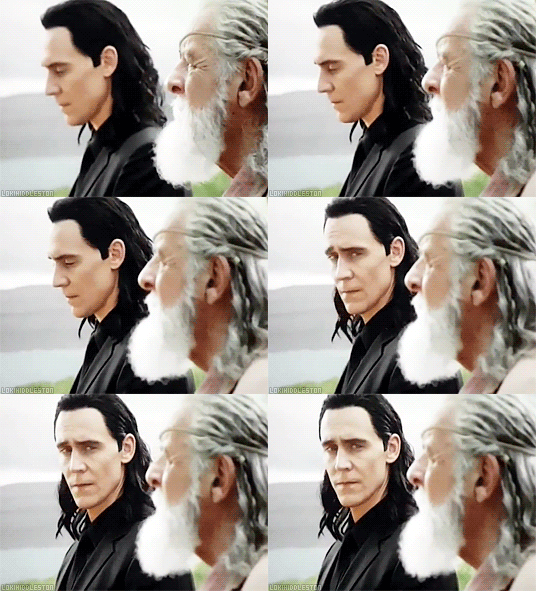
I do believe now that when Thor was talking to Korg about Mjolnir it dawned on him that very moment that… he was actually thinking of Loki. Look at his face.
Notice how Thor pauses there, contemplating what Korg said. He’s thinking of his brother.
Recently I read a post on reddit explaining how the “revelation” Thor had later on was about deciding to let Loki go if he wanted him back.
But when exactly in the movie did he get that “revelation”, and what did he mean by that anyway…? It’s never clearly explained.
“Since we last spoke”, that is since they were both in Thor’s cell. And what happened right after that?
THIS.
THIS is the exact moment when Thor had the epiphany that “open communication” (like he tried to do so many times in the past) “was not their family’s forte”.
And if he wanted to get through to Loki he had to talk in a language he would understand, and use other methods. Mischief and reverse psychology.
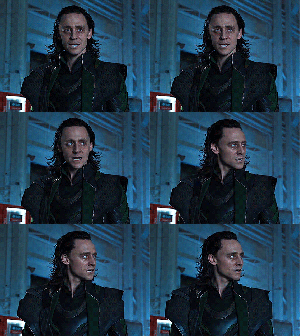
This is the exact expression he gave to Thor during the elevator scene: the surprise at hearing something he so desperately needed and the sadness because it’s too late. In this scene, he recognizes that Odin is dying, and in the elevator scene, Thor tells him that he thought the world of him only in the past tense, so there’s acceptance in his gaze but also a wistfulness.
The story begins and Loki points his dagger at the head of Thanos.
Ends the story and Thanos tells Thor:
“You should have aimed for the head”
So…
Did Loki know about Thanos’ weakness?
By Ìrimë
🤔
@mylokabrennauniverse
Oh, yes great observation. They have a sad history together and I’m
sure, they have known each other well. As Thanos has known that Loki’s
weak point must be Thor, Loki was also aware of Thanos’ weakness.
Mostly, because we know well that Loki is always with one step ahead of
his enemies. His considered phrases to Thanos, the pointing at his head,
his confidence can be the proofs of it. Maybe he tried to inform Thor
in a subtle way but unfortunately, Thor hasn’t noticed the sign.
This is another one of beautiful shots of Thor 1 that conveys a genius symbolism. Here’s Odin who pitted his children against each other for the throne and his unfair treatment of them set the brothers apart. And he is standing on a broken bridge. The bridge that was broken as the result of the brother’s conflict over the throne, over gaining Odin’s approval, over being worthy. The broken bridge of the brother’s relationship. The conflict that he fueled drove his children, literally and also figuratively on the verge of falling down into an abyss. The brothers are holding to the Gungnir, the symbol of the throne. Their hands are close to each other but the Gungnir, the throne has kept them apart. A symbol of how the throne and their rivalry for it, came between them and set them apart. And Odin, the real reason for the destruction of his family, is standing safely on the broken bridge, and he is holding Thor, his favorite son, by the ankle, while Loki is the farthest to him in this chain. A symbol of how his lies and his treatment of Loki, drove away Loki more than Thor and how in the end, they pushed Loki away, just like Odin’s “No Loki”. And as Odin had favored Thor and alienated Loki in all the years, here he held on to Thor and pushed Loki away and left him to fall in the abyss.
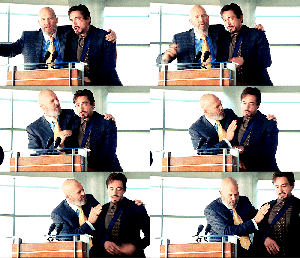
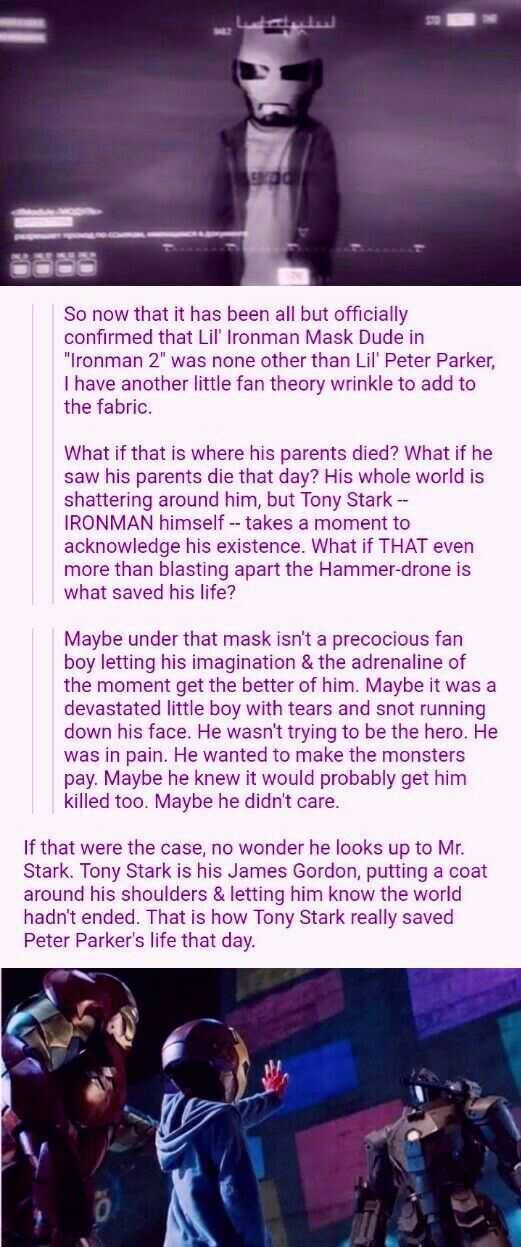
One of the reasons that Tony is hesitant to take on the role of mentor with Peter is because of Obadiah Stane.
We all know that Tony has a hard time trusting anyone and that he genuinely does care about Peter. But Obadiah’s betrayal not only as a business partner, father figure and mentor just shattered his faith in himself in that role for Peter.
Setting aside everything that happened with the Avengers in the Civil War, Tony really does care about Peter and taking on the role of mentor and defacto father figure scares him not only with Stane’s betrayal but Tony’s own lack of connection with his own father, Howard. So him embracing this role not only will help him heal from CW but helps him get passed Stane’s betrayal and Howard’s lack of parenting, and shows Tony that he can be that person that people can rely on not just as a teammate but as family.