It’s 7:47 AM on a Saturday and I need to rant about how beautiful this man is and how wonderful his character design is.
By all traditional senses of attractiveness, Héctor doesn’t even come close to fitting the mold. He’s tall, gangly, with ears and a nose so exaggerated in size that it’s comical. And it’s meant to be, but that’s part of his overall attractiveness and design. He’s supposed to be the opposite of Ernesto de la Cruz in every physical aspect so as to both compliment Ernesto, so that by appearance they would work together (in a similar fashion to Buzz and Woody from Toy Story) and to also make himself as unlike the other man as possible.
His thin face, strikingly wide cheekbones, messy, overgrown hair (you can tell it’s grown long because of the way it has 2 length cut along the neck and how his bangs need to be combed out, array of freckles and moles (HE IS COVERED IN FRECKLES how dare you sir), large eyes, bushy eyebrows, crooked teeth, higher forehead— all right down to the differing placements in favored facial hair— it’s all meant to offset him against Ernesto, especially in the shape of his face. If you drew both of their faces together, they would be inverted triangles to each other.
Héctor is often shown exerting feminine qualities throughout the film, from his ease to dressing in drag to his gentleness with children to his care for complete strangers—overall just being a very emotional person in general, with all of his motivation being driven by caring for his family—But here we also see some traditionally feminine aspects to his appearance. Long, fan-like eyelashes, bigger, soulful eyes, longer hair— And. His. Lips. They have a distinct curve and shading to them that makes them look fuller, more feminine. And yet!!! None of it takes away his masculinity!!! It’s so dang attractive and aesthetically appealing!!!! God, designers, just— GOD.
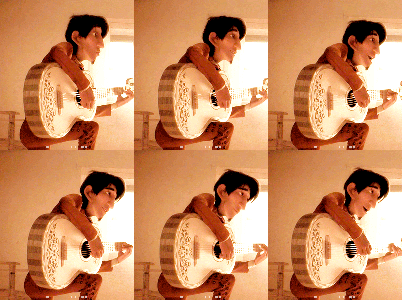
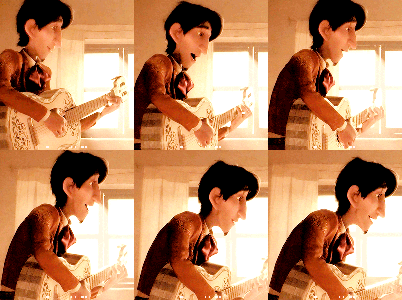
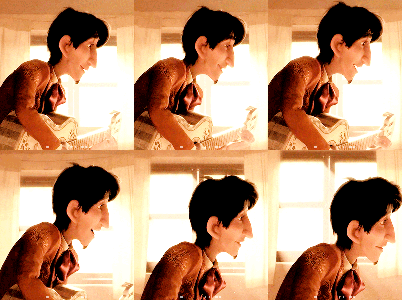
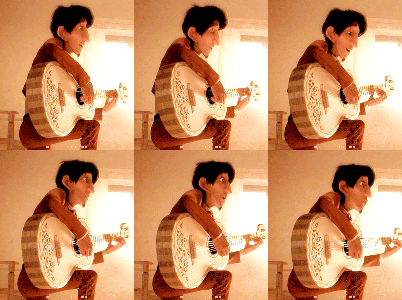
And his charro suit. Dear god, even his charro suit says so much about his character. Look at it in the gifs of Héctor trying to return home vs. the gif of Héctor singing to Coco. Look how faded it is in comparison. His charro suit is losing color the longer he’s away from home, faded, sun bleached, washed too many times, practically pinkish white, and m once again starkly different from Ernesto’s darker, maroon suit. Whereas when he’s with Coco, it’s more saturated, neater, lessfaded and threadbare and held together because he feels more held together when he’s with his family. Excuse me while I weep.
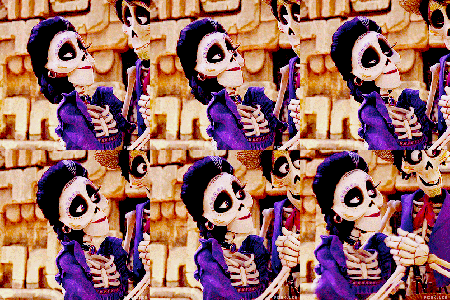
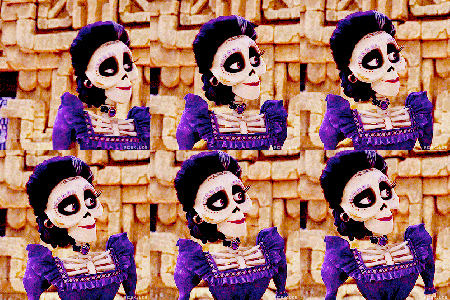
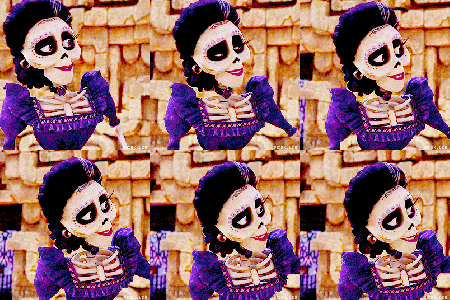
While Héctor’s face is complimentary to Ernesto, his body shape isn’t. They’re both broad in the shoulders, slim, and while Héctor is skinnier and a lighter than Ernesto, their body shapes don’t compliment each other like their faces do. WHEREAS. WITH IMELDA. Hector compliments her in spades. Her wide flowing skirt and slimmer upper body mesh so well with Héctor’s inverted body shape. And if you draw out her overall headshape, including her low braided bun, it meshed with Héctor, just like Ernesto’s.
Héctor and Imelda literally fit together. Both in personality, with all of her fire, tragedy, and authority— against his diffusing gentleness, comedy, and tenderness— AND in APPEARANCE.
This movie gave this man so much care in his character design. They made a tragic, lovable, beautiful goofball. And I will never be over it. Screw you Ernesto, this beautiful man was taken from the world way too soon.
I had to add a few more things that I was thinking about Héctor’s body shape. Because classically, it’s the body of a sidekick. The comic relief. The quickly moving body that’s made for flailing and waving.
Héctor is tall. Like… really tall. He’s built up higher, with long limbs that take more effort to fold and crouch than Ernesto’s shorter, more classical build. And yet, throughout the entire film, Ernesto is never shown kneeling or near the ground. He refuses. When Miguel is with him, he drags Miguel up to his level. But Héctor, who’s made of taller, gangly things, kneels for his daughter. He kneels when his wife is pushed down. He kneels besides Miguel. For people he loves, he folds his tall body to the floor.
Ernesto has every ability to show emotion. But he covers it so quickly with a default. When he’s about to kill Héctor his face shifts to anger, and by the time Héctor turns back, he’s smiling, opening his arms in welcome. But look at Héctor’s face. He doesn’t hide any of it. Every emotion is there. And it’s raw. And it’s real. And he lets it show. But that’s the same with Imelda, isn’t it? She does her best to hide behind anger. He’s her foil. For as angry as she gets, he reveals himself ever the more.
Héctor goes back because he’s homesick. Because he misses his family. His daughter. His wife. And he never stops missing them. And you see, here, that the only time he stands absolutely rod straight is when he’s talking about them. “I’m going home, Ernesto” he says, looking stern and foreboding for the first time. Only matched later in the film when his screams of “you took everything away from me”.
Héctor’s appearance is offset by that of his wife’s – who looks put together and elegant in life as in death. She’s stonier and colder. But he doesn’t ask her to be anything else- just as she doesn’t ask him to be another other than present. He foils her. When she calls him the love of her life, he melts, and she stiffens. But he doesn’t look disappointed. He looks happier. He knows that look. He knows her expressions. He’s taken the time to learn her. Not change her. Just as, after the movie ends, she doesn’t try to change him.
Héctor’s young. Really young. 21 years old. And yet, look at him. He’s about to give up his dream in that last panel. Look at how he stares at the music book. He’s holding his dream in his hands. And he frowns. And he thinks. You can tell his thoughts are spinning. And he closes it. He closes his dream. And he turns around, and looks at the door. Turns away. This isn’t his dream. It’s a love. But it’s not as important. It’s not his dream. His daughter is. He closes the book.
Sharp faces are usually reserved for women and villains. But look at the way Coco cups her fathers face. It’s the idea of foils. Of opposites. That something so sharp can become so soft. Can be held so carefully.
MY FAVORITE THING is that the classic Disney character built like him -skinny legs, skinny arms, long torso, long face- are made to move quickly. They’re the comic relief. The side kick. And Héctor does fall into that role. Because it’s something that holds him together mentally. Be happy. Be happy. Be happy. Saying it over and over in the way his body moves and twists around. But look how he moves when he’s with children. With is daughter. He slows. He moves gently. Carefully. He’s no longer a comic relief because his daughter needs a father. Not a character.
And that’s what kills me the most.
That all characters who are built like him are comic relief. Did you know, by the way, that people in broadway musicals hired to be that part are called character actors. Because those are such characters, they need to be played by only the quickest, most animated people.
But Coco doesn’t need a character. She needs her father. And its in those scenes that we see Héctor going against every bit of his composition to be that.

































 Stop talking and start doing: My Fallout Shelter for my Tumblr blog