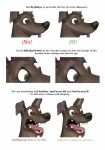
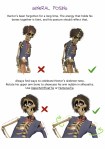
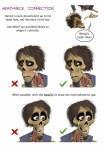
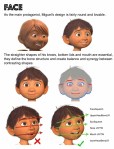
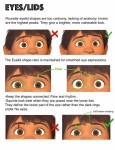
Sample pages from Dante, Héctor and Miguel’s model sheets. This was the Bible for the Animators who were animating these characters. (Via @leeunkrich on twitter)
He can’t sew in a straight line to save his life, but more than half the time will somehow manage to sew his sleeve on to whatever he is working on. Twice he gets his finger bones jammed in the machinery (which is luckily nowhere near as horrific an accident as it would have been if he was alive, but does take up time and risk breaking the machines).
The guy tries his best, but it is abundantly clear where the shoemaking Riveras got their talent from and it was not from Héctor’s side of the family.
He’s also actually pretty clumsy, especially now.
He’s kept the Shantytown habit of constantly removing his limbs, but hasn’t quite gotten used to the idea that now he’s better remembered his bones are held together much more firmly. The sudden influx of memories has also affected his gait, making him walk straighter and move his arms less. He hasn’t gotten used to this either and what it essentially means is that he suddenly has way less of an idea how to use his own body and has to get used to it all over again.
Plus he was often clumsy in life as well and a bit of a daydreamer, and that hasn’t changed. He basically can’t walk into the workroom without knocking something over, or off the table, or nudging somebody at a critical moment.
Eventually Imelda tells him that much as she loves him and is glad that he’s back in their lives, she would appreciate it if he could just… never touch anything in the workroom again. Ever. Under any circumstances. In fact, better yet, just stay out of the workroom altogether. For the sake of the business and general family sanity.
Héctor actually takes this pretty well, mainly because he’s just so thrilled that nobody expects him to try and make shoes any more. He knew as well as anybody that he was rubbish at it, and while his family were patient with him, he could sense that they were getting tired of explaining everything to him twenty times and having him still not get it.
They put him in charge of selling the shoes instead, something he is actually good at, being fairly extroverted and practiced in persuading people to do what he wants. (Though his sales tactics do border on the agressive sometimes, and occasionally the other Riveras have to remind him that “no, Héctor, you can’t promise them the chance to meet Frida Kahlo if they buy our shoes. Apart from anything else, Frida hasn’t agreed to any of this and yes people will complain and probably ask for their money back if you break your promise.”)
When he’s not needed in the shop, he works as a musician— though he never plays at any venue more than at most a few hours from the Rivera’s shop. People have made him offers, but he refuses to spend even one night away from home.
Sometimes, he wishes that he shared the family skill at making shoes. It seems to mark him as different from the rest of them and is one more reminder of the time he spent away from his family.
Ultimately, though, he knows it’s pointless to wish that he could just slot back into their lives like a missing jigsaw piece. His going away changed his family forever and his coming back has changed it too. It’s not the same shape as it would have been, but that doesn’t mean that it isn’t a good shape to be.
They stay in the guest room, which is small but very comfortably furnished, with a rose bush right outside the window, and right after they settle in Imelda gives them a tour of the workshop, and Hector leads the tour around town. Imelda and Hector are admittedly a bit nervous about showing their humble home and little town to royalty, but they’re very proud of where they come from and what they’ve built together, and besides–Tiana and Naveen have become very close friends and whatever nervousness they felt immediately dissipates at the beginning of the tour, especially when Tiana comments on the town’s beauty and warmth.
Of course, they fall in love with the plaza.
Hector plays his guitar with a group of mariachis, Imelda singing, and they start the night out with a cumbia that has Naveen basically leaping out of his seat and pulling Tiana with him to dance.
Of course Naveen can’t help but want to be a part of the band, so while he’s up there with his guitar, Tiana ends up in a mini dance lesson with Coco, who’s showing her her favorite dance moves with the adorable dress that Eudora made for her which she’s been wearing for the past few days because she loves it n_n
I think Ernesto definitely had all kinds of complicated and hidden feelings suddenly rise to the surface in that moment. After all, he and Héctor had spent their entire childhoods together, they had a lot of good memories. If Ernesto’s spent nearly a century trying to forget what he’d done, who knows what kind of nostalgia suddenly blindsided him at seeing Héctor’s picture, the living face he’d gone so many years without seeing.
Of course it couldn’t last too long, Ernesto’s spent too many years lying to himself and others for his facade to crumble that easily, but who knows, maybe for that brief moment, that picture reminded him of the good he’d had, not just of the evil he’d done.




 Stop talking and start doing: My Fallout Shelter for my Tumblr blog