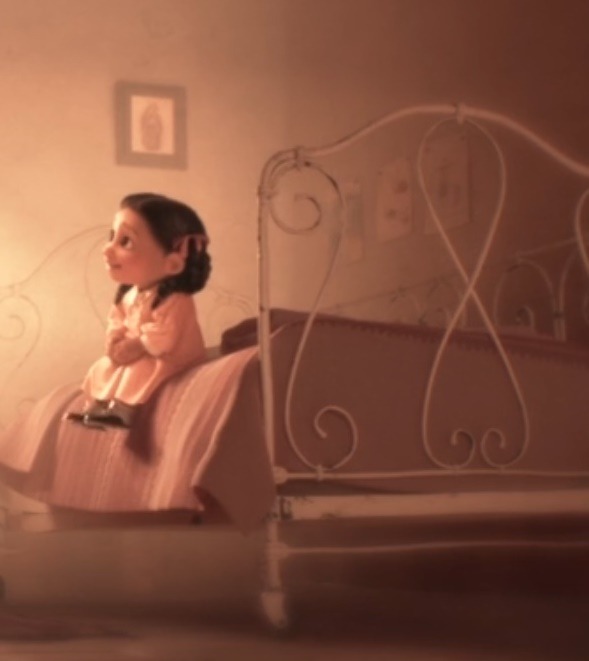
There are drawings on the wall behind Coco’s bed!! I’m not too certain about the first two, but the last one looks like it could possibly be an adult wearing a sombrero, standing next to a kid?? A drawing Coco did of herself with her
Papá?? It is my headcanon now, yes, thank you.
I wrote a lil’ snippet of a thing to go with it because how could I not.
Edit: Fixed a historical inaccuracy, kinda of a huge one XD. Thank you to @galaxymadisonn for pointing it out!
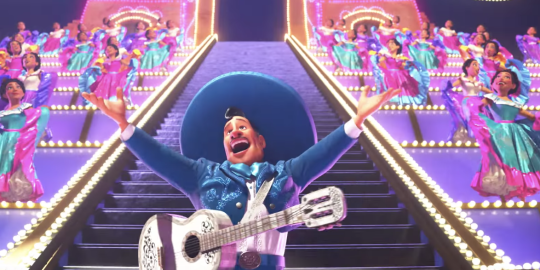
I just love this move of Ernesto’s so much, ok. He doesn’t just let go of Miguel’s hoodie, he shoves it away from himself. He’s going through a moment of pure rage where he also feels threatened and this movement reflects his state of mind just beautifully. I can’t help but marvel at this sort of thing because there were so many possibilities to go with about this simple gesture but like this, it feels just right. The way movements, gestures and expressions have been animated for this film is simply fantastic to me and I love it with all my heart.
So I was looking for a gif or screenshot that showed the facial markings Héctor gave Miguel–he has the ones around his eyesockets, of course, but he also seems to have some on his forehead. Specifically, three little swipes in the middle.
But as I was looking for gifs, I ran across this one, and…
It’s 7:47 AM on a Saturday and I need to rant about how beautiful this man is and how wonderful his character design is.
By all traditional senses of attractiveness, Héctor doesn’t even come close to fitting the mold. He’s tall, gangly, with ears and a nose so exaggerated in size that it’s comical. And it’s meant to be, but that’s part of his overall attractiveness and design. He’s supposed to be the opposite of Ernesto de la Cruz in every physical aspect so as to both compliment Ernesto, so that by appearance they would work together (in a similar fashion to Buzz and Woody from Toy Story) and to also make himself as unlike the other man as possible.
His thin face, strikingly wide cheekbones, messy, overgrown hair (you can tell it’s grown long because of the way it has 2 length cut along the neck and how his bangs need to be combed out, array of freckles and moles (HE IS COVERED IN FRECKLES how dare you sir), large eyes, bushy eyebrows, crooked teeth, higher forehead— all right down to the differing placements in favored facial hair— it’s all meant to offset him against Ernesto, especially in the shape of his face. If you drew both of their faces together, they would be inverted triangles to each other.
Héctor is often shown exerting feminine qualities throughout the film, from his ease to dressing in drag to his gentleness with children to his care for complete strangers—overall just being a very emotional person in general, with all of his motivation being driven by caring for his family—But here we also see some traditionally feminine aspects to his appearance. Long, fan-like eyelashes, bigger, soulful eyes, longer hair— And. His. Lips. They have a distinct curve and shading to them that makes them look fuller, more feminine. And yet!!! None of it takes away his masculinity!!! It’s so dang attractive and aesthetically appealing!!!! God, designers, just— GOD.
And his charro suit. Dear god, even his charro suit says so much about his character. Look at it in the gifs of Héctor trying to return home vs. the gif of Héctor singing to Coco. Look how faded it is in comparison. His charro suit is losing color the longer he’s away from home, faded, sun bleached, washed too many times, practically pinkish white, and m once again starkly different from Ernesto’s darker, maroon suit. Whereas when he’s with Coco, it’s more saturated, neater, lessfaded and threadbare and held together because he feels more held together when he’s with his family. Excuse me while I weep.
While Héctor’s face is complimentary to Ernesto, his body shape isn’t. They’re both broad in the shoulders, slim, and while Héctor is skinnier and a lighter than Ernesto, their body shapes don’t compliment each other like their faces do. WHEREAS. WITH IMELDA. Hector compliments her in spades. Her wide flowing skirt and slimmer upper body mesh so well with Héctor’s inverted body shape. And if you draw out her overall headshape, including her low braided bun, it meshed with Héctor, just like Ernesto’s.
Héctor and Imelda literally fit together. Both in personality, with all of her fire, tragedy, and authority— against his diffusing gentleness, comedy, and tenderness— AND in APPEARANCE.
This movie gave this man so much care in his character design. They made a tragic, lovable, beautiful goofball. And I will never be over it. Screw you Ernesto, this beautiful man was taken from the world way too soon.
I had to add a few more things that I was thinking about Héctor’s body shape. Because classically, it’s the body of a sidekick. The comic relief. The quickly moving body that’s made for flailing and waving.
Héctor is tall. Like… really tall. He’s built up higher, with long limbs that take more effort to fold and crouch than Ernesto’s shorter, more classical build. And yet, throughout the entire film, Ernesto is never shown kneeling or near the ground. He refuses. When Miguel is with him, he drags Miguel up to his level. But Héctor, who’s made of taller, gangly things, kneels for his daughter. He kneels when his wife is pushed down. He kneels besides Miguel. For people he loves, he folds his tall body to the floor.
Ernesto has every ability to show emotion. But he covers it so quickly with a default. When he’s about to kill Héctor his face shifts to anger, and by the time Héctor turns back, he’s smiling, opening his arms in welcome. But look at Héctor’s face. He doesn’t hide any of it. Every emotion is there. And it’s raw. And it’s real. And he lets it show. But that’s the same with Imelda, isn’t it? She does her best to hide behind anger. He’s her foil. For as angry as she gets, he reveals himself ever the more.
Héctor goes back because he’s homesick. Because he misses his family. His daughter. His wife. And he never stops missing them. And you see, here, that the only time he stands absolutely rod straight is when he’s talking about them. “I’m going home, Ernesto” he says, looking stern and foreboding for the first time. Only matched later in the film when his screams of “you took everything away from me”.
Héctor’s appearance is offset by that of his wife’s – who looks put together and elegant in life as in death. She’s stonier and colder. But he doesn’t ask her to be anything else- just as she doesn’t ask him to be another other than present. He foils her. When she calls him the love of her life, he melts, and she stiffens. But he doesn’t look disappointed. He looks happier. He knows that look. He knows her expressions. He’s taken the time to learn her. Not change her. Just as, after the movie ends, she doesn’t try to change him.
Héctor’s young. Really young. 21 years old. And yet, look at him. He’s about to give up his dream in that last panel. Look at how he stares at the music book. He’s holding his dream in his hands. And he frowns. And he thinks. You can tell his thoughts are spinning. And he closes it. He closes his dream. And he turns around, and looks at the door. Turns away. This isn’t his dream. It’s a love. But it’s not as important. It’s not his dream. His daughter is. He closes the book.
Sharp faces are usually reserved for women and villains. But look at the way Coco cups her fathers face. It’s the idea of foils. Of opposites. That something so sharp can become so soft. Can be held so carefully.
MY FAVORITE THING is that the classic Disney character built like him -skinny legs, skinny arms, long torso, long face- are made to move quickly. They’re the comic relief. The side kick. And Héctor does fall into that role. Because it’s something that holds him together mentally. Be happy. Be happy. Be happy. Saying it over and over in the way his body moves and twists around. But look how he moves when he’s with children. With is daughter. He slows. He moves gently. Carefully. He’s no longer a comic relief because his daughter needs a father. Not a character.
And that’s what kills me the most.
That all characters who are built like him are comic relief. Did you know, by the way, that people in broadway musicals hired to be that part are called character actors. Because those are such characters, they need to be played by only the quickest, most animated people.
But Coco doesn’t need a character. She needs her father. And its in those scenes that we see Héctor going against every bit of his composition to be that.
So we know that Héctor’s songs are often about people he cares about. The most notable examples being ‘Remember Me’ (about Coco) and ‘Poco Loco’ (about Imelda).
So just saying, what if ‘The World Es Ma Familia’ was actually written for Ernesto?
For one thing, it’s the opposite of ‘Remember Me’, which was written to be sung to only one specific person, in that the song only really works when it’s being sung to an audience. Because unlike Héctor, Ernesto would never sing just for himself or a loved one. From his perspective, music is just a means to an end.
And, though obviously this wouldn’t affect how Héctor would have written it (although the film does seem to have quite a rich lore, so it wouldn’t surprise me if the filmmakers hadn’t come up with this themselves) it’s the only song Miguel ever sings for Ernesto.
Also, there’s the significance of the line, “the world es mi familia"— the world is my family. It’s kind of similar to Ernesto’s own “seize your moment” catchphrase in that it can sound pretty inspirational when you first hear it but actually has the potential to be quite disturbing in the right context. Unlike Héctor, Ernesto doesn’t feel tied to his family (though we know he must have had one, because he doesn’t deny it when Miguel asks him if it was hard to leave them— probably he had parents or siblings or something), or to his friends.
Look at how easily he turns from loving Miguel to trying to kill him— despite the fact that he never actually finds out that Miguel isn’t related to him (his response to finding out that Imelda is Miguel’s grandmother isn’t “I’m not your great-great grandfather after all?!” it’s “you’re related to Héctor?!”, which to me suggests that he’s wondering if he somehow hooked up with Héctor’s daughter or cousin or something).
Why wouldn’t he? Ernesto doesn’t need a family. The world is his family. He is on so many strangers’ offrendas that he doesn’t know what to do with all the offerings he gets— what does it matter if he has to bump off one friend to get to the top?
Apart from that, however, there’s very little meaning to the song. Admittedly it’s cut off halfway through, but the lyrics seem to just be the singer greeting the audience for an evening performance, telling them what a pleasure it is to play for them and then repeatedly telling them how much he enjoys music in general (because it allows him to communicate with people and bring them closer to him).
Even ‘Juanita’ which, since Héctor didn’t expect Miguel to have heard it, we can assume was written post mortem (head canon that it was written specifically to entertain Chicharrón— possibly as an apology for the whole femur incident) and just for fun, has more detailed lyrics than this. But it fits Ernesto, who doesn’t seem to care what he’s singing as long as the audience enjoys it.
This guy just found out his once-best friend murdered him for fame, and the next minute gets his former friend’s grandson dropped in front of him with no witnesses. A more vindictive person could’ve had a lot of fun getting their own back just about any way they wanted.
What does Héctor Rivera do? He hugs the kid.
He obviously wasn’t expecting the scared-child cannonball-hug prior to this, but he’s not blaming Miguel for Ernesto’s crimes. (He wasn’t even mean to “Ernesto’s grandson” really the entire evening, despite him already knowing that Ernesto stole and profited from his songs. Once Poco Loco came around he was even happy. Getting upset over finding out Miguel’s family was looking for him was pretty mild, all things considered. This person is a very kind man.)
The look on his face right before this hug. The moments of disbelief that Miguel is even here, followed by the stunned, worried stare: Ernesto has this sweet, wonderful, talented grandson who adored him without ever even meeting him, and he threw him away.
This is… Héctor can hardly even process this. Just…why?
Callous. Wasteful. Cruel. Ernesto has tossed this amazing child into a pit and left him to die and someone like Héctor can hardly understand how anyone would do such a thing.
“It’s okay. It’s okay.” (you didn’t deserve this. it’s not your fault.)
Of course he will hug and comfort the distraught and abandoned child. It’s who he is. If Ernesto doesn’t want this blessing he’s been handed so freely, then Héctor will take care of it. He found the Chamaco first, anyway.
Let me start this by saying that I define human Villains as
characters that don’t use magic or powers to do evil, they’re being bad on
their own volition using things that every day people can use, and that’s what
makes them scarier in my opinion then most of the other characters in the
Disney/Pixar Staple of Villains.
The reason I’m starting to think that Ernesto is by far and
away a great villain is because he is human in nature. It’s an interesting
situation here in Coco with how he’s presented. Unlike other villains, who don’t
have a claim to fame in the same sense as he does in world, Ernesto oozes the
whole issue of what we see on screen vs. who the actor/actress truly is. We’ve
seen in recent years that people equate a person’s character on screen to who
they are off screen. Which leads to some very awkward moments for fans and
actors alike. Ernesto has that going for him. He’s a person that shows himself
to be one way but ultimately is not as he appears. On top of that he died
young, making him a character that has the added mystique of people putting
their own views and spins on his history, and making him a tragic figure.
In Coco, we are painted a picture through Miguel’s point of
view on Ernesto. He’s being forced to not play music and so becomes infatuated
by Ernesto and sees him as a larger than life person. What’s interesting about
this is that, while the town embraces him, they also seem to be using him as a
tool for their own revenue stream. We see with his monument that there are
marigolds in there, but they are limited unlike the other grave sites. Clearly,
while the town does respect him as one of their “favorite” sons, they also only
see him as someone at a distance, an image on screen, a character and not the
real person. Miguel ups that, wanting to be like the image that Ernesto shows
the public in interviews and movies, and we see that Miguel is infatuated with
Ernesto the character that he plays and not the real person who he is.
When we finally do get to the land of the dead, again, we
see Ernesto the celebrity, and not the person. People seem to adore him as a
musician, but also are using him for their own push forward. To play at his
party is a big thing, and Ernesto seems to revel in that celebrity as we see at
the party he likes to smooze (to ingratiate himself) with some of the bigger
people in Mexican (and Spanish) history. He employees a number of people for
his event, much like he probably did in real life, and creates an event where
he makes it seem like they are important but he’s clearly the star of the show.
This much like the whole town using him for the contest and other events happening
during Day of the Dead.
But how much of this image is a cultivated thing and how
much is the real Ernesto. I propose it’s half and half.
Ernesto diving into the
water to save Miguel was a legit thing, he wasn’t doing this for fan fair and
for the audience it sets him up as a decent person, which, he at first, seems
to be. Now does this make him a good person, no by no means, but it does paint
him as more human, as we see that he can be capable of doing the right thing. However,
this only adds more to the whole fact that he is, in fact, not a good person,
but a very narcissistic, cowardly, criminal one.
Taking a look at his actions in film we can see a very
different Ernesto in regard to the real person based on his actions and what we
have to look back on after the revelation of his murderous act. So where do we
even start with finding the real Ernesto, well we have to start off at the
beginning of his career with Hector. We know both men grew up in the same town,
and given how Hector calls him his friend and such, we have to assume they are
about the same age, so likely boy hood friends, or at the very least they knew
one another growing up. If not growing up, then at least when they were teens
or older.
We know that Ernesto can sing and play on his own, this much
is clear from the movies and his actions during the party. This is important as
it puts a rather big mark on his reasoning. Ernesto is a good singer and
player, but he can’t write his own songs. He can perform Hector’s works but can’t
write them himself. Meaning that he was never trained in creating music, just
playing and possibly reading it.
This puts Hector as someone very important to
Ernesto’s goals, and he sees his friend much more as a tool and something that
he needs with him at all times. During the moment of Hector’s death, we pretty
much get that from Ernesto as he pleads with him to stay.
The thing is I think that the fact that Ernesto was good
looking, could play, and sing, probably got the attention of a lot of people in
town. Unlike Hector who, let’s be honest, while good looking, is still skinny,
tall and during the time period that they were alive, would have been seen as
gangly and unattractive for a movie star. Ernesto probably, being fed from a
young age, that he was good looking, and gifted, became more narcissistic and
probably became heavily interested in becoming a star at a young age.
From the look of the flashbacks and the films that we see,
we can assume that Ernesto got his start during the 30s and 40s, maybe into the
50s of cinema. It’s clear that the movie style is based on the period of time
of black and white cinema, but not so far back that it’s the Silent Movies.
This means that Ernesto more than likely had the goal, early on, of becoming
famous as he felt that he could never just sing for one person, that he had to
have the world love him, and that he wasn’t about to let anyone get in his way.
This adds a lot to how he is as a person. He’s determined to the point of
murder, he’s so determined to be seen as someone great and amazing and loved by
all that he’s willing to kill to get to that point and his Ego is beyond the
pale.
Which brings us to his actions with Hector. Again, assuming
that the two knew one another and were probably good friends, Ernesto more than
likely saw talent in Hector and realized how useful to him he could be. If he
were to sing Hector’s songs he could become well known, as the songs were
amazingly beautiful and meaningful. So the plan more than likely was for Hector
and Ernesto to travel to Mexico City or the surrounding area where a good
percentage of Mexican movies were being in the 1930s and 1940s. Ernesto most
likely didn’t care that much about Imelda and her relationship with Hector
outside of the fact that it could throw a wrench in his plans. We get the
impression that Imelda probably was not too keen on Hector leaving with
Ernesto, who undoubtedly made a plea to Hector about making a lot of money if
they became famous to help fund his family.
In the moment when Hector was leaving Ernesto we saw that
they were nearly at the goal that Ernesto was looking for. The duo more than
likely had traveled for quite some time, as evidence from Mama Coco’s letters.
So this wasn’t a simple case of a year or so, this was possibly a number of
year that they were on the road preforming. Eventually the fact that Hector was
home sick and realized that it was not going to happen for him and Ernesto in
regard to getting well known for their music made him want to go home. This is
where I think Ernesto’s fears and desires trumped his moral code.
We know for fact that Ernesto pleaded with Hector not to go.
Not because he was going to miss his friend, but because without Hector’s music
and skills, he was going to not have a way to make it big for himself. It
became evident to Ernesto that he didn’t need Hector if he had his song book. So
that became the obvious thing to him. Get the book from him at all costs. We
clearly see he’s willing to poison his friend, but, what makes it so much
worse, is what he does after.
He took the guitar, something that had significance to
probably Imelda, Coco and Hector. The fact that he was willing to take the
guitar, use the Guitar, and clearly care for it brings to light some info about
Ernesto that either makes him out to be a real scumbag even more, or someone
that has some semblance of guilt, no matter how small. We know the Guitar was
taken well care of. If Ernesto truly hated Hector, he probably wouldn’t have
taken it and still took care of it. However, the issue becomes why. The more
reasonable thought could be that there was a bit of guilt on his part for
killing his friend and keeping the guitar with him was a way of both keeping Hector
with him and dealing with that guilt. It was, in some subconscious way, a way
for him to say “I’m guilty of a crime” since Imelda, if she saw the movies,
probably would have recognized the guitar and, being a clever woman, possibly
would have put two and two together as Hector more than likely wouldn’t have
given away a guitar like that willingly. We also know that it was put in the
tomb for Ernesto, so clearly he did make sure that it was kept safe.
On the other hand, we’ve seen later how much of a jerk he
can really be, and that brings us to the fact that he possibly took the guitar
because it was worth a lot as a gimmick and had no regret of really killing his
friend. I’m more inclined to think it’s the later seeing how cowardly he
becomes when Imelda and the others go after him to get the picture. There’s
also the fact that his reputation trumps everything else and we also see this
in how he talks to Miguel after the big reveal and even before that.
When Ernesto first discovers that he has a grandson, his
reaction is interesting. He doesn’t deny it, and embraces it, but the look on
his face says that he both doesn’t understand and at the same time is freaking
out mentally. It’s pretty clear, given the ladies in the movies, he’s known as
a romantic lead, and it wouldn’t be that hard to believe in that period of time
that he willingly went to bed with a few different women. This means he’s probably
wondering which one he got pregnant, so clearly he probably does have some
unknown kids or a child running around if he’s willing to buy Miguel’s story
without any proof of who the woman was. He doesn’t even ask about his
grandmother. He just goes with it.
Later when he was going to give Miguel a pass back to the
land of the living, he points out that he doesn’t want people to know that
Miguel is his grandson, as if that would ruin his reputation. It’s made more blatant
that Ernesto doesn’t seem to care about anyone but himself, since, rather than
sharing all the “love” that his fans gave him, he hoards it and shows it off to
Miguel.
It’s an interesting moment because you realize how alone Ernesto really
is since if you go back to the town, while he has a lovely tomb, there is no
food or drink or wine on his alter, meaning that there was no one there other
than the locals to tend to it. So clearly the town even knew of his attitude if
they were not willing to put up more offerings on the alter.
This brings us to the point about his actions with Hector,
Miguel and the family during the ending. We see that he is willing to throw
both Hector and Miguel into a hole to hide the truth. This begs the question
of, who else did he get rid of to keep his face? If he’s willing to kill
Hector, then it’s not that big a shock that he could be willing to steal and
kill to get other roles and get rid of people he doesn’t want in his life. He
throws Miguel off the roof, and pretty much threatens the family due to, what
he believes, is his power and influence in this world. Now while I would love
to believe that he would be punished for his actions by fading. The problem is
that, while there is proof of him being a thief of music, there’s no proof of
him killing Hector. This means that there are probably people out there that
either don’t buy the idea that Ernesto stole the music, or they don’t care as
he went on to become the singer of their favorite songs.
This brings me back to the point that as far as Villains
come, Ernesto is probably one of the best human ones that Disney has had in a
long while, and I hope that people really do support him in that sense. We need
more nuanced villains in stories, and Ernesto probably will be a good start to
that.
Things I learned from the ingenious and somehow more heart wrenching Junior Novelization of Pixar’s Coco!
-Hector is truly infamous in the Land of the Dead’s Grand Central Station. The woman who stops him at the gate not only knows him by name but remembers Hector’s previous attempts to cross the marigold bridge, and has seen through all of his hair-brained schemes. She even warns him, “You know the drill…” before calling security. I wouldn’t be surprised if all the security guards placed a bet around Dia de los Muertos, All of the guards and receptionists and greeters trying to guess what Hector’s plan will be, when he’ll try to crossover, how long it takes before anyone hails him in, etc.
-Hector actually has 2 dimples, and not just one like I’d previously imagined! Though in his photo in the film, it looks like one is deeper than the other, favoring the same side as Miguel’s single dimple. But the book explicitly says he has 2.
-Shantytown and the poor souls who live in it are a treasure and Deserved Better (I wish some of their dialogue had made it into the final movie). When the deceased Riveras are tracking Miguel, they passed through shantytown and the place where Tia Chelo and her friends were playing poker, only to find that their game table is abandoned, along with other sad scenes of other souls fading away. Those poor dears… (The Land of the Dead should SERIOUSLY consider opening some kind of a Retirement home for the nearly forgotten!)
-Before going on stage and singing Poco Loco, Hector tells Miguel that the secret of the perfect performance is to sing with the people you care about in mind, like your singing to them and only them with all your heart. Hector implies that he does this whenever he sings, thinking of “someone still in the Lamd of the Living”. When Miguel finally gathers up the courage to sing, he thinks of singing to Mama Coco, the only Rivera who ever loved music as much as Miguel. Although we don’t know it at the time, in that moment, Hector and Miguel both think of the same person when they wish to Sing For The Person They Love Most. (And yes, I had to take five minutes to cry before continuing)
-Miguel once wrote a song for Ernesto de la Cruz and spent all of his allowance on a mug as offerings to his hero. Upon discovering the piles of gifts Ernesto has received from the Many ofrendas raised in his honor, he realizes Ernesto has probably never even see his offerings.
-During Hector’s flashback, he recounts how during his travels with Ernesto, he’d wake up in so many hotel rooms, all of them so alike and repetitive that he often forgot what town he was in and would feel very disorientated from homesickness. Pobrecito…
-Mama Coco never stopped thinking about her Papa, in spite of years of living under her mother’s scorn of him and music. She even pretended to dance to music that Hector used to play to her, and sang to baby Miguel! (Possibly sparking the child’s love of music) I wonder if the song she hummed to him was Remember Me… 💛💜💀 I Hope So
-It’s implied in the book that Mama Coco passed away “a few months” before Dia de los Muertos, possibly implying she died some time in July or August. Assuming that Miguel’s mother looks about 5 or 6 months pregnant earlier in the film, this could mean that the baby was born in February or March, implying that Mama Coco got to meet her baby granddaughter! At least, I hope so anyway.
-Upon finally being allowed to cross the bridge, Hector sings as he walks (in a brand new pair of Rivera shoes, blister free! Thanks to Imelda), Coco dances to his singing, and Imelda harmonizes with Hector. They can finally sing, dance, and count their blessings together, for the first time in nearly a century.
-When Miguel learns that crawlspace he used as his musical haven in the attic was the same space that Mama Coco used to dance, he finds an old pair of dance shoes she used to wear and polishes them all sparkling and new. He brings it to Mama Coco’s grave as an offering, so that she may dance to her heart’s content in the afterlife.
-Hector, in spite of being much more put together than the previous year, still carries some cheeky skeletal habits. Unseen to Miguel, he uses his own skull as a drum, and his ribs as a washboard to add more rhythm to chamaco’s music.
So yeah. This book killed me in the best possible way. 💜💛💜💛💜💛💜💛
ALSO!!!! THERES AN AUDIOBOOK FOR IT TOO, DUBBED BY THE AUTHOR!!!! AND ITS SO GOOD YOU GUYS ITS SO GOOD
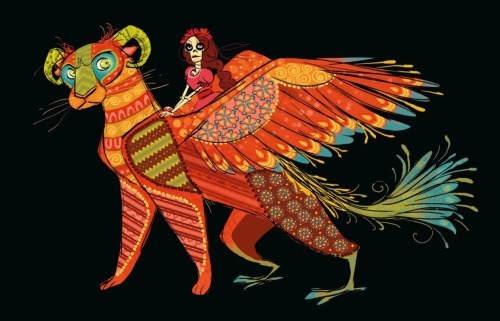
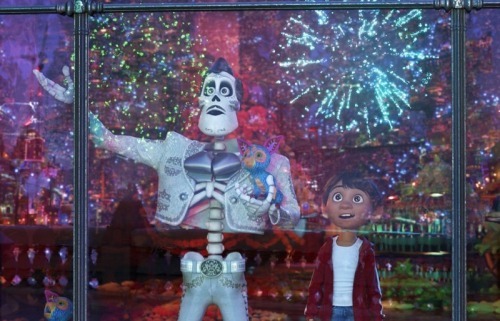
Tbh I love how in Coco the characters have alebrijes that actually, like, represent them as spirit animals.
Miguel and Dante are both goofy and energetic characters loyal to each other and arguably have one of the best dynamics in the movie.
Imelda and Pepita are both stern and sassy (and powerful af) characters at the beginning of the movie that eventually both shed their cold exteriors and reveal well-intentions towards their loved ones,
Ernesto has, oddly enough, chihuahuas, which seem completely out of character when they’re first introduced. When it’s revealed that Ernesto is in fact the antagonist, it shows that he himself is like a chihuahua; sure, pretty charming and harmless at first, but underneath those adorable facades are heinous, malicious monsters.











 Stop talking and start doing: My Fallout Shelter for my Tumblr blog